Friday, November 11, 2005

Baffle


A Channel Baffle Chute

BA•FFLER. n.s.

       [from baffle.]

He that puts to confusion, or defeats.

Experience, that great baffler of speculation, assures us the thing is too possible, and brings, in all ages, matter of fact to confute our suppositions.
        Government of the Tongue.

Helen Keller Reading Raised Print, photograph’d by Marshall (1902)
Reading and talking to myself.

See Anne Mansfield Sullivan (ca.1867-1936): “Miss Keller does not as a rule read very fast, but she reads deliberately, not so much because she feels the words less quickly than we see them, as because it is one of her habits of mind to do things thoroughly and well. When a passage interests her, or she needs to remember it for some future use, she flutters it off swiftly on the fingers of her right hand. Sometimes this finger-play is unconscious. Miss Keller talks to herself absent-mindedly in the manual alphabet. When she is walking up or down the hall or along the veranda, her hands go flying along beside her like a confusion of birds’ wings.”

Franco Siron, “D’Aprés Picasso” (1947)
Thinking for no ascertainable reason of a band call’d “Your Mother” I used to listen to in some sweaty cave in the industrial wasteland of Ithaca, New York, down along Route 13. First heard a version of “Nobody Ever Call’d Pablo Picasso an Asshole” out of that band.

Thursday, November 10, 2005

Truck


Agee (Let Us Now Praise Famous Men):
Emma’s paper suitcase is lifted into the truck beside the bedsprings which will sustain the years on years of her cold, hopeless nights; she is helped in upon the hard seat beside the driver above the hot and floorless engine, her slippered feet propped askew at the ledges of that pit into the road; the engine snaps and coughs and catches and levels on a hot white moistureless and thin metal roar, and with a dreadful rending noise that brings up the mild heads of cattle a quarter of a mile away the truck rips itself loose from the flesh of the planed dirt of the yard and wrings into the road and chucks ahead, we waving, she waving, the black hat straight ahead, she turned away, not bearing it, our hands drooped, and we stand disconsolate and emptied in the sun; and all through these coming many hours while we slow move within the anchored roundures of our living, the hot, screaming, rattling, twenty-mile-an-hour traveling elongates steadily crawling, a lost, earnest, and frowning ant, westward on red roads and on white in the febrile sun above no support, suspended, sustained from falling by force alone of its outward growth, like that long and lithe incongruous slender runner a vine spends swiftly out on the vast blank wall of the earth, like snake’s head and slim stream feeling its way, to fix, and anchor, so far, so wide of the strong and stationed stalk: and that is Emma.
What I want’d, what a reach’d into the massy text to lurch up with: “we slow move within the anchored roundures of our living,” or maybe just “anchored rondures” is what stung me into seeing. And pulling it out brought up all the marvelous tough roots and rootlets, clung full of clods of dirt and debris and a sole earwig halved and eating its own hindquarters, that kind of recklessness that Agee’s prose romps in—I know no other like it, though I am remind’d somewhat of Marguerite Young’s ariatic whoosh in Harp Song for a Radical. I love how it is all so perfectly tuck’d between two “Emma”s. One Emma here in the rag-apron’d bosom of family, one there—“that is Emma”—that is, gone, nowhere, annihilated. All one hears at the end of that sentence is the roar of blood coursing in one’s own ears.

~

To note: a book title’d Poets Talk: Conversations with Robert Kroetsch, Daphne Marlatt, Erin Mouré, Dionne Brand, Marie Annharte Baker, Jeff Derksen and Fred Wah, by Pauline Butling and Susan Rudy (University of Alberta Press, 2005)


I thrash’d about in the Jeff Derksen pages, collect’d Derksen saying:
One of my poems—“Jerk” or “Jerk Jeff Derksen” . . . talks about wanting an art more complicated than The Gap. The Gap outsources for its labour. They can make T-shirts more cheaply in Malaysia than in Hong Kong, but making a shirt with a collar is cheaper in Hong Kong. So if you went to The Gap and spent a couple of hundred dollars on looking like a Gap person, then actually you’re wearing all the contradictions of capitalism on your body . . . you are kind of hauling this stuff around.
Which made me think of Gap nothing, though it did make me think of “flarf” (and similar “sampling” techniques) as a kind of outsourcing, a “making cheaply.” Alors, what “stuff” exactly do “flarf” products “haul around”?

And (collect’d, I did) the following parenthetical factoid (just the kind of thing I love) in Derksen remarks regarding a poem call’d “Neighbourhood”:
Then I put the square brackets (in the Vancouver tradition of using square brackets, like Kevin Davies’ Pause Button) as kind of an authorial intrusion into the poem:
. . .
david did idle lentils
slug luggage gage
genuflect ectomorph physical [more 1970s
for me] meal lame me . . .
Follow’d by a mischievous remark: “Because I was a copyeditor and a proofreader I use all the punctuation in the standard forms. So the square bracket is the authorial or editorial intrusion into a text.”

And: an exchange with Pauline Butling regarding a Steve McCaffery comment that “the demise of the phenomenological voice is what these poems provide us with.” To Butling’s question whether the comment makes sense to him, Derksen says:
Well contextually it does. It was written in 1990 or something like that when there was a struggle going on between writing communities—the refigured subject that Language poets and post-language writing were trying to construct, and the more self-assured or stable phenomenological subject, the unified or stable subject.

Pauline: Is “the phenomenological self” unified and stable? I wonder if he was referring to voiced poetry.

Jeff: Yes, I think so. The tension is between a poetics of speech and what’s supposed to be the great rupture that initiates the Language poets, the “I hate speech” (“On Speech”) essay by Robert Grenier. But one of the most stable phenomenological subjects I can think of is Ron Silliman in his big project, Alphabet. So this question was worked out antagonistically in a discourse of poetics, but not so in the poetry.
No comment. I love the sheer bafflement of origin stories. See baffle.

Wednesday, November 09, 2005

Interrupt’d


Stacks serendipity. Bolt’d up, as I am liable to, to hie myself into the stacks in search of James Agee (it’s a desire implacable that I suffer, an itch unscratch’d, cannot “settle” before gathering a small heap of somebody’s words, oddly, unknowing how it’s trigger’d, how it’s suddenly Agee, and not Willa Cather). So: stacks confront’d, I pull down a copy of the Letters of James Agee to Father Flye (and think now it must’ve had something to do with Merton, that I should light out for Agee’s particular territory, bad boy religiosos both, one Catholic, one Episcopalian, only one of whom’ll straighten “up.”)

[Answer the ’phone, knowing it’s my son, with a deprecatingly perfervid “Hynyah!”—an all-purpose karate chop of a greeting—mostly because I’m addled by my one post-work (regimen) beer and no grits, and a tiny voice surround’d by deep sea creatures with light’d weed-resemblant appendages, creatures who bark and mutter, says “Khalid?”]

[—Not in Kansas anymore, Toto, you reprobate, you recidivist, you hash!]

[A second caller—identifiably not the first, though expect’d—calls with a message that Edgar Knows Publishing would like me to prendre un pot with them. At my confusion, I am deliver’d the question: “Have you had a recent brainwash or something?” Ah, offspring! Sprung off th’imical boat!]


Alors. Stacks. Pulling down the Father Flye epistle-exchange, out sails a cardlet, white, and flops a series of sags in the air all the way to the pediment. Chancy word-endeavor laying it all on the line. Here’s what it read:
And the rhyming hills complained. In the noontime stillness,
Thawing our frozen beans at the raw face of a fire,
We heard the frost-bound tree-boles booming like cannon,
A wooden thunder, snapping the chains of frost.

Those were the last years of the Agrarian City
City of swapped labor
Communitas
Circle of warmth and work
Frontier’s end and last wood-chopping bee
The last collectivity stamping its feet in the cold.

                          Thomas McGrath
                          Letter to an Imaginary Friend
And turning to the mark’d page, how fleet Agee is, with perception and lasso to bring it sturdily down. A paragraph out of an April 20, 1927 letter (Exeter, New Hampshire):
I’ve read very little until the past two weeks. In that time I’ve read Manhattan Transfer, by John Dos Passos. It’s an unalleviatedly filthy book; when it’s bellyful of sexual fifth it descends to coal-dust and orange-peels. But it’s very cleverly done. I hate mere cleverness, so I’m glad to think there’s more than that to it—he’s really a marvelous writer, and the novel is built in an entirely new way. Also, I think for some reason that he writes filth sincerely disbelieving in the existence of anything else—that he’s not a cheap hack-writer, writing Pay Dirt. And the book is full of lovely descriptions—passages of poetry as fine as any I know for color and beauty alone. Then I’ve read The Plutocrats by Tarkington. It’s rather thin and tepid, but a delightful antidote for the more rabid and intolerant parts of Sinclair Lewis’ books. The idea is to glorify Babbitt, to set him up as a barbaric giant Carthaginian—and at the same time to make rather small and foolish the people who belittle him. I thought Lewis had done it sufficiently in Babbitt; but this is much fairer. But by no means as great a book, since its very publication depends on the writing of Babbitt. I’ve today begun to read An American Tragedy, which seems rather fine, in spite of stormy criticism. Dreiser’s English is bum, yet it has a peculiar beauty and excellence. You feel you’re reading a rather inadequate translation of a very great foreign novel—Russian, probably. He’s horribly obvious, and has no humor. But this dullness is a relief from the heady brilliance of Dos Passos or Lewis—and he has a tenderness, a love for his character, that rarely slobbers and is usually strong and fine.
Incredible sleights of hand there. Vague thinking if anybody reads Dos Passos now, I mean—for formal reasons. Tarkington’s Penrod things quaintly satisfy’d my youth, Lewis serves (still?) to nurture the social consciences of adolescents, and Dreiser, whom I read as a long-hair’d lad and complain’d mightily to my blonde companion of that tragic tic of “And yet—”? “Dreiser’s English is bum.”

Happy, too, with the formula—A is by no means as great a book, since its very publication depends on the writing of C. Maybe a little more of that kind of thing’d cut the burgeoning of derivatives (write-through, homage, thievery, gasp) to a trickle.

Walker Evans’s “Washroom and Dining Area of Burroughs’s Home” (1936)
Another sighting of the Spicerean desire for words to become things, real lemons rampant! Agee (Let Us Now Praise Famous Men):
If I could do it, I’d do no writing at all here. It would be photographs; the rest would be fragments of cloth, bits of cotton, lumps of earth, records of speech, pieces of wood and iron, phials of odors, plates of food and of excrement. Booksellers would consider it quite a novelty; critics would murmur, yes, but is it art; and I could trust a majority of you to use it as you would a parlor game.
~

Morning. A quash’d moment of mannerist ecstasy. Is mannerism only anticipatory to the next period style? That is, today’s mannerism, garish and irredentist, ’ll be tomorrow’s heap of reap-all precursory? Blink, blink, blink. Make it uncanny, make it undeniable, make it of tincture of hysteria. Someone else (the future) ’ll “smooth” the edges . . .

Tuesday, November 08, 2005

Fuss


Merton shooting.
The late James Laughlin in Byways, the book of memoirs collect’d in 2005:
When I first went down
To Kentucky to meet Merton
At Gethsemani, his monastery
Near Bardstown, the abbot
Had invited me for a visit
After I’d published Thirty Poems,
I was expecting gloom and obsession,
Grouchy old monks ponderous
In penitence, glaring through
Their sanctity . . . how wrong I was!
To be sure, the background
Was not prepossessing: a drab
Countryside, scrubby trees,
Dry fields, not verdant,
Shacks and billboards along the
Highway; the buildings
Of the compound behind
Its walls monstrously ugly,
Gray stone blocks set square
Without any architectural
Distinction, the spire
Of the church a tin spike
Poking up at the sky
,
Over the gateway, in forbidding
Black letters PAX INTRANTIBUS,
It could have been a prison . . .
How wrong I had been about the inhabitants!
These brothers and monks
Were warriors of joy.
Happy and friendly, laughing
And joking, rejoicing in the
Hard life of work and prayer,
Seven services a day from Vigils
In the dark at 3:15 A.M. through
Lauds, Terce, Sext, None,
Vespers and Compline
in the dusk,
These chantings of supplication
For the whole world, even infidels
Not just for the monks.
Such brightness, lux in aeternitate . . .
The Guy Davenport penn’d Preface notes:
These carefully crafted lines, unornamented with rhyme and with an intuited prosody as flexible as speech, are not prose sliced up to look like poetry. They are in what should be known as The American Plain Style, Protestant and guileless, as useful to Kenneth Rexroth and Louis Zukofsky as to R. Buckminster Fuller, who wrote his Untitled Epic Poem on the History of Industrialization in it.
Which might conceivably serve to make my admiration of th’alignment of, say, spire and spike in the lines quoted, or the Bunting din of stone blocks set square look like gold-digging, or lily-guilding, but who cares? Further along Davenport claims that a “solid education (New England prep school, Harvard, and erotic conquests rivaling Byron and Casanova) steered him toward imaginative writing, at a great distance from blast furnaces,” and details how a “1538 Latin Homer by Andreas Divus was stolen, together with the briefcase it was in, and his annotated Cantos, when he was at a urinal in Pennsylvania Station on his way to lecture at Yale.”

For some years in my youth, I recall, I confused (interchangeable the two) Thomas Merton and Tom Dooley. Which one died of plugging in an electric fan in Thailand (presumably known then by the name of Siam?)

Han-shan and Shih-te by Tensho Shubun, Japan, mid 15th century.
Isn’t it always the least impeccable narcissist who attempts (always) to hide? Is Thomas Pynchon a narcissist? Is Han Shan? Is Emily Dickinson? What marks narcissism’s pincer movement—hiding and exulting—entry into the modern temper? Any paparazzi diary’ll spell it out: no sport in the self-evident. I rather liked the way some New York Times senior photography editor sent a brusque (read rude) note my way asking where I’d scored the Pynchon photograph I’d point’d at— Cowabunga! I forward’d it to my brother asking if he’d shot that one or’d I. And instruct’d th’editor to use the damn Google machine.

Identifiably Coelenterate (jellyfish)
Coleridge in February 1805 (soddingly inimical at pulling a baseline neologism—the “stuff” of life—out of ’s ear, or forking over an image seemingly irrepressible, apt, and ept):
Now how to get back, having thus belabyrinthed myself in these most parenthetical parentheses? Cut thro’ at once, & now say in half a dozen a Lines what a half a dozen Lines would have enabled me to say at the very beginning / but my Thoughts, my Pocket-book Thoughts at least, moved like a pregnant Polypus in sprouting Time, clung all over with young Polypi each of which is to be a thing of itself—and every motion out springs a new Twig of Jelly-Life /—
Diving into the Notebooks, meaning (is like): “‘Ah daddy, I wanna stay drunk many days’ / on the poetry of a new friend / my life held precariously in the seeing / hands of others, their and my impossibilities.” That old thing revivifiably there.

Monday, November 07, 2005

Suss’d


(Peter Culley point’d out the photograph and “The complete works of W. N. P. Barbellion (1889-1919)” here.)
Cold. Skittish in headband for the bicycle skitter in. Barbellion’s got moments of existential naught worthy of Sartre. Here, (March 8th, 1915):
On the top of an empty omnibus to-day I cast my eye for a second at a little heap of dirty used-up ’bus tickets collected by chance up in one corner. The sight of them unnerved me. For a moment I felt almost physically sick. This feeling was so instantaneous that it was some time later that I discovered the cause of it, when I began to reflect upon all the implications which the little heap of tickets sent ramifying through the eye to the brain—the number of persons, for example, that daily boarded this vehicle, each one bent on his little project, making use of the ’bus, then passing out of it again; the number of miles the ’bus traversed each day, the number of ’buses “honking” through the streets and all this cataract of London life. My nerves throbbed with the ache of it all. In London even the names over the shop windows scuffle and fight with one another and with you as you pass; advertisements on hoardings, walls, windows, scream at you, wheedle you, interrogate, advise, suggest. At all times the ear catches fragments of conversation as the crowds pass along the streets, or the trample of their footsteps as they rush up and down wooden stairways to the trains—both above ground and below ground—a maelstrom of activity.
Middle of the Great War, the young carrot-top Pound skulking about, reaping bitterness. Modernism about to forego trying to digest modernity in any “meaningful” way.

George “Smitty” Smith, Edward “Sonny” Bivins, Winfred “Blue” Lovett, Kenneth Kelly and Richard Taylor of The Manhattans.)

Sunday, November 06, 2005

Saturnine


Reading W. N. P. Barbellion’s The Journal of a Disappointed Man. Barbellion a young-dying British naturalist, pseudonym of one Bruce Frederick Cummings, dead apparently at the age of twenty-eight on the thirty-first of December, 1919. Author of, besides the Journal, a handful of essays (“The Passion for Perpetuation” is one), another near-dozen of essays in natural history (“Rousseau as Botanist,” “The Scarabee Monographed,” “Curious Facts in the Geographical Distribution of British Newts”—pertaining to the latter, there’s a journal report of B.’s holding a newt by the tail and hearing it emit a tiny squeak, trim spooky salience in a species supposed mute), and a couple short stories (“How Tom Snored on His Bridal Night”).

A sample (1907):
June 5.

A half-an-hour of to-day I spent in a punt under a copper beech out of the pouring rain listening to Lady ____’s gamekeeper at A____ talk about beasts and local politics—just after a visit of inspection to the Heronry in the firs on the island in the middle of the Lake. It was delightful to hear him describing a Heron killing an Eel with “a dap on the niddick,” helping out the figure with a pat on the nape of his thick bull neck.
And (1911):
February 13.

Feel like a piece of drawn threadwork, or an undeveloped negative, or a jelly fish on stilts, or a sloppy tadpole, or a weevil in a nut, or a spitchcocked eel. In other words and in short—ill.
Numerous tinier pleasures: the lady “with a tiny voice like the noise of a fretsaw,” or another’s—“voice piano to pianissimo, her conversation breaks off in thrilling aposiopoeses.”

Cover cotch’d at Soul Shower.
Finish’d Jonathan Lethem’s The Fortress of Solitude. And cued up a salutary groove of The Manhattans—“I’ll Never Find Another (Find Another Like You).” Only to weigh “I see you holding hands with a guy of a different face, yeah” in the meagre pans of my astonishment (we’re talking, aren’t we, about music with only the merest trace of irony allow’d, no?) What kind of lingo is that, if not consciously pointing to race?


A word Dr. Johnson apparently overlook’d, though the ubiquitous Lydgate’s got it crucify’d quite rosily, and a couple of Shakespeare’s running dogs got it, too:
saturnine, a. and n.

       A. adj.

       1. a. Astrol. Born under or affected by the influence of the planet.    b. Hence (in later use without allusion to the primary sense), sluggish, cold, and gloomy in temperament.

       Saturnine mount, in Palmistry = Mons Saturni: see MONS.

1433 Lydgate, “This cursid Bern, enuyous and riht fals, / And of complexioun verray saturnyne.” 1587 Greene, “The Saturnine temperature is necessarie to dry vp the superfluities of the sanguine constitution.” 1599 Nashe, “Saturnine heauy headed blunderers.”

Saturday, November 05, 2005

Oubliette


Charged with a sleek memory of G. enamour’d by the word oubliette. She reading Hugo’s Notre Dame de Paris. Freely: little hiding place wherein, formerly, one shut up individuals condemn’d to life imprisonment, or individuals one want’d to get rid of. Paris, circa 1972. Oublier meaning to forget.

Is it applicable to challenge th’efficacy of such word root and derive on the grounds a Sontag character (The Benefactor) challenges that of “the value of myth itself: ‘Such tales are just a sop for the credulous, picturesque concessions to those who cannot stand the shock of a naked idea.’” One is immensely attract’d to that “naked idea” without the least (cloth’d or not) notion of what it’d possibly “look” like. The “naked idea” is not invisible, it is inexistent.


Against the ploddingness of some of Pound, say, that underslung desire for “A set of cubby holes whereinto one can sort one’s values and make them into a schema”—always an impulse to be quash’d—Pound himself balances a sassy recklessness (what makes him palatable): “The gent. reader is warned that I shall now devote several pages to an analysis (of a sort) of the Nichomachean treatise. Those in search of daisies and scintillations had better skip the next pages.”

When I “had” about thirteen years (a Manichean age), my ambition drove me to announce plans for a magazine call’d Daisies & Demons. Long hours pass’d in design of a possible cover, entwine of flat flower and flat horn’d devil physiognomy.

Friday, November 04, 2005

Becloud’d


Susan Sontag (by Annie Leibovitz)
Sontag (The Benefactor):
. . . the appetite for thinking must be regulated, as all sensible people know, for it may stifle one’s life. I was more fortunate than most in that, in my youth, I had no settled ambitions, no tenacious habits, no ready opinions which I would have to sacrifice to thought. My life was my own: it was not dismembered into work and leisure, family and pleasure, duty and passion. Still I held back at first—keeping myself free of unnecessary entanglements, seeking the company of those whom I understood and therefore could not be seduced by, yet not daring to follow my inclinations toward solitary thought to their conclusion.
Solomon Burke
Scuffling about I uncover’d Village Voice’d remarks about Jonathan Lethem’s The Fortress of Solitude made by Robert Christgau—he calls it “the finest rock and roll novel since (or before) The Commitments,” (that Roddy Doyle thing I didn’t read) in the course of noting “Lethem's two-CD, not-for-sale tribute to the music [the novel’s main character Dylan] Ebdus grew up to.”

Funny, I never once thought of the book as a “rock and roll novel.” I thought Mark Twain, childhood and race. Mostly race, undauntedly and excellently so. Though: isn’t rock and roll (and all its variants) mostly about race anyhow. Isn’t the music “industry,” like the fashion “industry”, scored precisely by race (and class) thievery? The source of new music (styles) coming deftly “up” out of the black community, gradually “whiten’d” for mass consumption? New meaning get put (even) to those “angelheaded hipsters” “dragging themselves through the negro streets at dawn looking for an angry fix”—it’s that search for the (authentic) commodifiably new, no?


Ezra Pound (Guide to Kulchur). [In the Confucian “Analects,” talk of the “six becloudings”]:
The love of firmness without the love of learning, whereof the beclouding conduces to extravagant conduct.
      . . . in the ideogram called “beclouding” we find confusion, an overgrowing with vegetation . . . “Extravagant conduct” is shown in a dog pawing a king or trying to lick the king’s ear, which is said to mean a dog wanting to rule.
A lot of that is visible in the poetry precincts, no? In the poetry “industry”?

Thursday, November 03, 2005

Stench


“A Sharpshooter's Last Sleep,” photograph’d by Alexander Gardner, at Gettysburg, Pa. in the “Devil’s Den,” July 1863
~

SMUTCH CITY BREAKDOWN


Some kind of unclad skank
fortifying going down in th’air

today, whiffs of the brutal
cafeteria, John Marzetti leftovers, that

and exhaust squirt, and blood
cakes. “The only thing we

knew for sure about Henry
Porter is that ’s name

wasn't Henry Porter.” Oh, don’t
start that again, lost somewhere

in the Commandrine lunch bucket,
Podunk sharpshooter in one hand.

There I could never be
a boy cut of whole cloth

mental voltage, “logical, for use,”
I have wasted my life.

~

The book to the floor, that was the first heave.

Wyndham Lewis, “Ezra Pound” (1939), Tate Gallery, London
Fossicking the Pound’s Guide to Kulchur (E.P. in groan and sepulchre didst give me that word “fossick,” I like to think it means digging oneself into a big hole):
Certain colours exist in nature though great painters have striven vainly, and though the colour film is not yet perfected. Truth is not untrue’d by reason of our failing to fix it on paper. Certain objects are communicable to a man or woman only “with proper lighting”, they are perceptible in our own minds only with proper “lighting”, fitfully and by instants.
Next which somebody’s writ near imperceptibly, in pencil—“Asshole time.” Though under the smutch of my gaze I see it more properly says—“Absolute truth.”


Indefatigable Paul Valéry says: “I do not know whence I derive this very lively sense of the arbitrary. Have I always had it, or have I acquired it?” Or in the year of Wittgenstein’s Tractatus he addresses th’Académic Française (on th’occasion of ’s “ascension”), only to compare “those writers who relieve us of the burden of thought and who dextrously weave a luminous veil over the complexity of things . . .” against those “others, whose existence must be deplored, who have elected to strike out in the opposite direction. They have placed toil of the mind in the way of its pleasures. They offer us riddles. Such creatures are inhuman.”

~

The head against the wall, that was the second heave.

Wednesday, November 02, 2005

Shanghai’d


Claude Aspère (The Sayings of Claude Aspère):
Art is vomit, uncontainable, trajectory’d, hurried up by fever. Think only to the projectile vomiting of children and addicts to ascertain its “naturalness” in the cosmick tremelo of all things. Art is a ridding, no more. To scoop forth another man’s vomit and label it parcel of one’s own: that is not art. One’d as well do to collect scabs and make a mosaickal history of this sad world. Yea, to fall to the earth dog-like and purge oneself well, that is the function of art.
~

Shanghai’d by lexickal impertinences out of Johnson's Dictionary:
VO•MITORY. adj.
          [vomitoire, Fr. vomitorius, Lat.]

Procuring vomits; emetick.

Since regulus of stibium, or glass of antimony, will communicate to water or wine a purging or vomitory operation, yet the body itself, after iterated infusions, abates not virtue or weight.
      Brown’s Vulgar Errours.

Some have vomited up such bodies as these, namely, thick, short, blunt pins, which, by straining, they vomit up again, or by taking vomitories privately.
      Harvey on Consumptions.

~

To VO•MIT. v.n.
          [vomo, Latin.]

To cast up the contents of the stomach.

The dog, when he is sick at the stomach, knows his cure, falls to his grass, vomits, and is well.
      More.

~

To VO•MIT. v.a.
          [vomir, Fr.]

1. To throw up from the stomach: often with up or out.

As though some world unknown,
By pamp’red nature’s store too prodigally fed,
And surfeiting therewith, her surcrease vomited.
      Drayton.

Vomiting is of use, when the foulness of the stomach requires it.
      Wiseman’s Surgery.

2. To throw up with violence from any hollow.


Or O.E.D.’d (oedevotee, oedevious, oedelicious, oedamn’d):
shanghai, v.
1. trans. a. Naut. slang (orig. U.S.). To drug or otherwise render insensible, and ship on board a vessel wanting hands.

1871 N.Y. Tribune 1 Mar. (Schele de Vere Americanisms, p. 347), And before that time they would have been drugged, shanghaied, and taken away from all means of making complaint.

1887 S. SAMUELS Forecastle to Cabin 46 To be carried or forced on board of a ship in this manner is what is termed in sailor parlance being shanghaied.

1909 Chamb. Jrnl. July 440/2, I have got the Grand Duke pretty well shanghaied.
~

That mistake of letting a post-repast shut-eye go late, only to find oneself buzzing with wakefulness at midnight. Scoot’d through more of The Fortress of Solitude, with no inclination to collect tidbits, though I think it terrific. Up to the mid-part, a dozen or so pages call’d Liner Note between the childhood chapters of Underberg and the (presumably) chronologically distant chapters of Prisonaires. Thinking how it thus mimicks the structure of both Sula and To the Lighthouse. And what’s the notorious sentence or two in Flaubert’s Sentimental Education that “solves” the problem of time’s passage? “They _________’d, they travelled.” (Revery of reading that book in Albany, adhered to the dirty porch-couch one whole slayingly hot summer. Who would’ve thunk that that skimming the flat pancake of my brain’s stone off a paragraph I’d been instruct’d to see as instructive would . . . oh forget it.)


Valéry (Monsieur Teste):
The words I and Me point to our central ignorance . . . and evoke it.
      It is impossible to think “of oneself” otherwise than in one particular and particularly sensitive way.
      Observation: It happens that the knowing-knowledge moment (which is a kind of act) may be remarkably meaningless . . .

Tuesday, November 01, 2005

Yes, Oaf


Betwixt tossing candy’d fobs at the Edvard Munch Scream-outfit’d that troop’d by, I fossick’d the pages of a distill’d book of Coleridge’s Notebooks. There’s a man who proceed’d regularly by huge unchewable mouthfuls, ambition itself caught in the craw. What’s stunning is that he complete’d anything in the roil of intent, lists of lists. I like the oddities:
Bright Reflections in the Canals of the blue & green Vitriol Bottles in the Druggist’s shops in London.
Mere plictri-plactri—

Very fond of Vegetables, particularly Bacon & Peas. Bacon & Broad Beans. —

Poetry without egotism comparatively uninteresting —
Mem. Write an Ode to Meat & Drink

A dunghill at a distance sometimes smells like musk, & a dead dog like elder-flowers. —

On a better-most sort of Remark of Dr Johnson’s recorded by Boswell —
                                a notable Flea-skip for so grave a Bug.

Injury Scotchmen have done our Language —

What a beautiful Thing urine is, in a Pot, brown yellow, transpicuous, the Image, diamond shaped of the Candle in it, especially, as it now appeared, I having emptied the Snuffers into it, & the Snuff floating about, & painting all-shaped Shadows on the Bottom.


Received: No: A Journal of the Arts, No. 4 (2005), edited by Deb Klowden and Ben Lerner ($12, 39 West 29th St. 11A, New York, New York 10001) Cover by Che Chen.

Writings by Robin Blaser, Beth Anderson, Cyrus Console, Robert Creeley, Russell Edson, James McCorkle, Cole Swenson, Peter Gizzi, Mary Jo Bang, Clark Coolidge, Barbara Guest, David Shapiro, Erin Moure, John Yau, Carla Harryman, Ken Irby, Marjorie Welish, Mei-mei Berssenbrugge, Renee Gladman, Pier Paolo Pasolini (translated by Michelle Cliff), Charles Baudelaire (translated by Keith Waldrop), Ann Lauterbach, David Perry, and Charles Bernstein.

Paintings by Marjorie Welish.

Essays by Forrest Gander (on Maria Negroni), Arthur Danto (on Philip Guston), Michael Clune (on Kevin Davies’s Lateral Argument), Lisa Jarnot (on Robert Duncan), and Ben Lerner and Aaron Kunin in dialogue (on Marjorie Welish).

Philip Guston, “Outskirts”
One immediate delight: the Danto sketch on mandarinism / authenticity in the case of Philip Guston’s exhibition of “notoriously oafish pictures of Klansmen in the Marlborough Gallery in 1970,” resulting in “a major outcry.” “‘It was as though I had left the Church,’ [Guston] said in a talk he gave in 1978. ‘I was excommunicated for a while.’ Among painters, only de Kooning, who had made a comparable but somehow far less incendiary gesture in 1953 in showing his great Woman paintings at the Janis gallery, supported what Guston had done. The Women, though figural, were built up of slashes of pigment, effectively like an Abstract Expressionist canvas. But Guston’s hooded figures were like comic strip characters in Mutt and Jeff.

And: “All the great Abstract Expressionists discovered a signature style. Guston’s was thought mandarin because it did not seem as if it came from the guts, which was the favored organ of artistic authenticity in that era.”

Danto argues for something like a gradual “apostasy,” quoting remarks Guston made at “a panel on the future of abstraction, held at the Museum of Modern Art in 1960”:
There is something ridiculous and miserly in the myth we inherit from abstract art: that painting is autonomous, pure, and for itself—therefore we habitually analyze its ingredients and define its limits. But painting is “impure.” It is the adjustment of “impurities” which forces its continuity. We are image-makers and image-ridden.
And breezing that against so many poèsies pures, in the issue of No at hand, frankly, what I long for (in the “scene” generally) is more oafishness. Not the recombinant superior gleaming machine-oafishness of flarf-generators, but the droopy drawers, stumbled-down, anything goes inheritors of the Biotherm-esque O’Hara, Berryman’s big mess, and Ammons’s barrages of garbage. Or Bernadette Mayer’s dishevel’d junkyard dog opus, or Alice Notley’s sass in the filigree. Ain’t there a chill despotic cleanliness, a shard-preciosity, all around now? More splendid piss-burn and rags and jags! More guffaw and bêtises! More spilt Willies!

Philip Guston, “The Studio” (1969)

Monday, October 31, 2005

Brute


Scoot’d through the first hundred or so pages of Jonathan Lethem’s The Fortress of Solitude. Spaldeen, play’d in the Brooklyn streets with a pink-color’d rubber ball. Is that a bastardization of Spalding? The ball manufactory? The way Seeburg juke boxes in the south got call’d Seabirds?

Peter Gizzi
Oobleck, a Suess goo. Relationship to o.blek, a journal of the language arts?

(Was it Ken Fifer, whose house in Bethlehem, Pa. burn’d down, who wrote a poem call’d “Me Being Stupid”? I always rather liked that.)


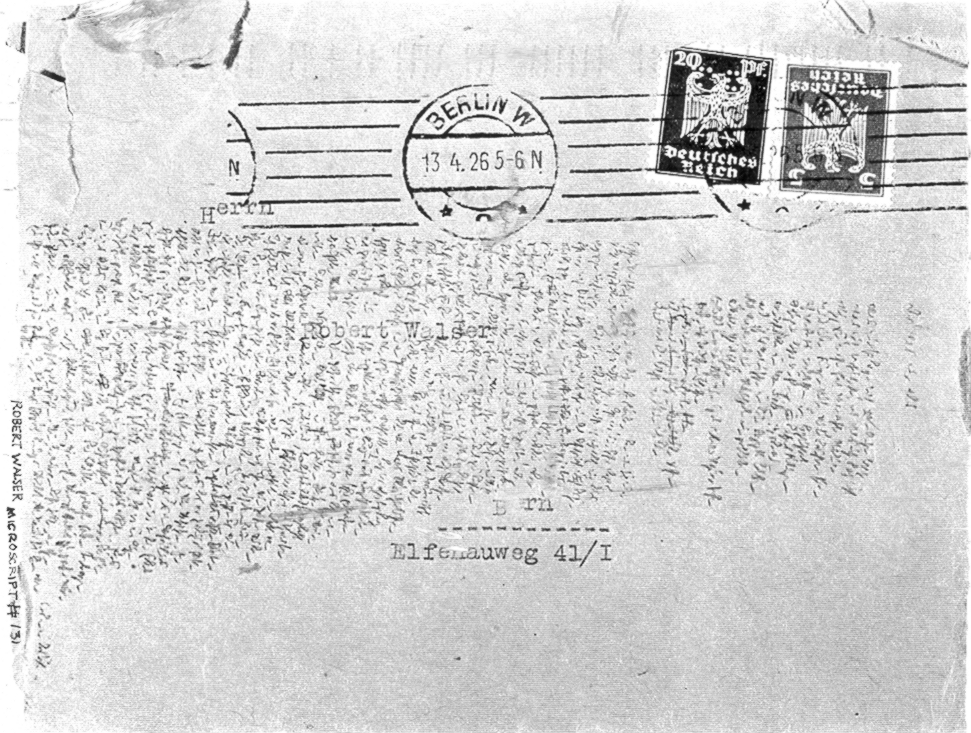
Poking around in a newish Robert Walser thing, Speaking to the Rose: Writings, 1912-1932, translated by Christopher Middleton. Which includes “fourteen translations from what has come to be called the ‘pencil area,’ or ‘Bleistiftgebiet.’


“The ‘pencil area’ was for a long time thought to be a corpus hermeticum, closed to the mortal mind because composed in an entirely private cipher. It was by matching certain strips of script to extant published texts that Jochen Greven first showed that the cipher had been all along an adroitly, if most idiosyncratically, abbreviated script. The 526 packages of this writing now fill 2,000 pages in the six volumes of Aus dem Bleistiftgebiet, 1985-2000, edited by the meticulous decipherers Bernard Echte and Werner Morlang. So here was a real trouvaille: sometime even before 1924 or 1925, Walser had begun to pencil, on the backs of calendars, on blank spaces offered by rejection slips, telegrams, bank statements, and other sorts of used stationery, an immense reserve of stories, feuilletons, sketches, improvisations, from which to extract, at will, fair copies.”

(It’s possible, one thinks, that items—often writing-saturated—gather’d in places like the Prinzhorn-Collection, or the Musée de l’Art Brut in Lausanne, be codify’d awaiting decipherment.)

Walser: “It can so happen that, for example, horses are unduly put to work, because they cannot speak and thus cannot be asked. They are unable to negotiate. No horse can be asked for its opinion, for nature has denied it the ability to pronounce one. It is altogether disgusting the way human beings do not refuse such delicacies as frogs’ legs . . .” Beginning to spiral off into a consideration of war, with the line “who smiles a fine snaky rhetoric out of his mouth,” and eventually ending with the sentence: “With prayer it is certainly not a matter of succeeding, or accomplishing something useful, but first and foremost of its being beautiful.”

~

Guffaw’d at midnight, reading about Lethem’s nerd white boys, Arthur Lomb and Dylan Ebdus. Arthur, the nerdier, trying to talk the talk: “‘Man, that one guy was trying to act real scary, but I could see his face, he looked like a baby, his lips were all blubbery. Yo, I probly could of taken him if you hadn’t come out just then. Lucky for him I’d say, yo.’ Arthur’s careful slurring of certain words, in contrast to his sharply nerdish pronunciation elsewhere, is wincingly obvious to Dylan, who wonders why Mingus doesn’t just smack him upside the head and command him to stop . . . Arthur turns to Dylan instead. ‘What you think, we could of taken them, yo?’
        ‘Don’t yo me,’ said Dylan.”

Sunday, October 30, 2005

Fort


Finish’d The Volcano Lover.

“Passion for S . . . was vehemence, aggression. What he could not understand is a passion that finds happiness in a retreat from vehemence, which makes one self-withdrawn. Like the passion of the collector.”

        “Because an image can show only a moment, the painter or sculptor must choose the moment that presents what the viewer most needs to know and feel about the subject.
        “But what does the viewer need to know and feel?”

“. . . the reigning cliché about the achievement of classical art: that it showed suffering with decorum, dignity in the midst of horror . . . ‘As the bottom of the sea lies peaceful beneath a foaming surface,’ Winckelmann wrote, evoking the standard offered by the Laocoön, ‘so a great soul remains calm amid the strife of passions.”

(The Winckelmann who was murder’d, not unlike Pasolini, by one of ’s lovers.)

The Portland Vase (Copy)

        “One February mid-afternoon in 1845, a young man of nineteen entered the British Museum, went directly to the unguarded room where the Portland Vase, one of the museum’s most valuable and celebrated holdings since its deposit on loan by the Fourth Duke of Portland in 1810, was kept in a glass case, picked up what was later described as “a curiosity in sculpture,” and started beating the vase . . .
        “The malefactor, discovered to be an Irish dainty student who had dropped out of Trinity College after a few weeks’ study . . . said that he was drunk . . . or that he was suffering from a kind of nervous excitement, a continual fear of everything he saw . . . or that he heard voices telling him to do it . . . or that he envied the maker of the vase . . . or that he had found himself aroused by the figure of Thetis, recumbent, awaiting her bridegroom . . . or that he thought the vase’s depiction of erotic longing a sacrilege, an offense to Christian morals . . . or that he couldn’t stand to see such a beautiful thing be so admired while he was poor and lonely and unsuccessful. The usual reasons given for destroying objects of incalculable value, admired by everyone. These are always stories of a haunting. Self-defined outcasts and solitaries, almost always men, begin to be haunted . . . The ravishing object is there. The object is provoking them. The object is insolent. The object is, ah, worst of all, indifferent.”

The Cavaliere, that is, th’aristocrat: “The first principle of the science of felicity is not to succumb to indignation or self-pity.” (A man unable to speak the word happiness.)

The five renamed months of the short-lived Republic in Naples: “Piovoso (rainy), Ventoso (windy), Germile (budding), Fiorile (flowering), and Pratile (meadowed) . . .”

Cartolina francobollo annullo postale: a memoria del 1779 (Commemorative stamp).
Sontag offers the last word to Eleonora de Fonseca Pimentel, publisher of the principal newspaper of the Republic, executed: “I was born into that world, I belonged to that class, I experienced the charms of that very agreeable life, I rejoiced in its unlimited vistas of knowledge and skill. How naturally human being s adapt to abjection, to lies, and to unearned prerogatives. Those whom birth or appropriate forms of ambition have placed inside the circle of privilege would have to be dedicated misfits—disablingly sanctimonious or bent on self-deprivation—not to enjoy themselves. But those whom birth or revolt have cast outside, where most beings on this earth live, would have to be obtuse or slavish in temperament not to see how disgraceful it is that so few monopolize both wealth and refinement, and inflict such suffering on others.”

And: “I cannot forgive those who did not care about more than their own glory or well-being. They thought they were civilized. They were despicable. Damn them all.”

Saturday, October 29, 2005

Kid


Most refreshing reading attended: Kate DiCamillo reading a few chapters of her newest: Mercy Watson to the Rescue. Mercy is a pig. No windbag introduction full of flattery, self-flattery, and lies. No third party digs. No self-important asides by the Q & A crowd (though one self-identify’d “teacher” did hint at possible fraud in DiCamillo’s notion of writing somewhat blindly, that is, WITHOUT AN OUTLINE). No fashion-preening by the crowd, no putting on the trappings of the indigent, the trappings of the crazed. Attention honed to the point of one boy—following along in the book—’s blurting out “Crack!” just when “Crack!” happen’d. DiCamillo recount’d rather ruefully how, after a twenties spent sitting in coffeehouses in a black turtleneck, she determine’d to write two pages a day (“That’s a novel a year”) and ’s stuck to it. Recount’d her dead-end job history: at Disney, an eight-hour day of saying, “Look down here, look at your feet.”

Latest most favour’d blog: Aphidhog’s Georgia Sam. (“He had a bloody nose.”) A free-floating terror-humoresque attach’d to a juicy succulent or a poet’s feedbag somewhere in the British Isles.


Revery-report: Trying to do the layout (involving a piece of posterboard the size of two storefronts, text blocks of roughly one storefront-dimension each, an intermittently taut piece of twine stretch’d out by two cowboys, numerous ladder-straddling and roof-perching helpers, me on a ladder with a hammer and a mouthful of tacks) for what I suppose one’d call the elephant (wooly mammoth?) edition of Ted Berrigan’s Collected. Nobody’d work together, everything kept coming up crooked. All of it taking place against the pots and pans and sundries-hung façade of a “Wild West” general store.

And, intermingle’d with th’above, the tiniest conversation. Ange Mlinko: “You put my constellation up,” pointing to a perfect row of four stars with another, a fifth, just akilter. Me: “Yeah, what a terrific alignment.” (So Starred Wire gets acclaim’d by the dream-mould.)


T. E. Hulme, attaining the rank of Spicerean real lemon in “Notes on Language and Style”:
It is seeing real clay, that men in agony worked with, that gives pleasure. To read a book which is real clay moulded by fingers that had to mould something, or they would clutch the throat of their maddened author. No flowing on of words, but tightly clutched tense fingers leaving marks in the clay. These are the only books that matter—and where are they to be found?
And, some stray lines:
[Defining language.] Large clumsy instrument. Language does not naturally come with meaning. Ten different ways of forming the same sentence. Any style will do to get the meaning down . . .

[Under Prose.] A sentence and a worm are the most stupid of animals and the most difficult to teach tricks. Tendency to crawl along requires genius, music to make them stand up (snake charmer).

[Earlier.] The poet makes it stand on end and hit you.

[Last remark.] All theories as toys.

Friday, October 28, 2005

Swing


Out late listening to Mark O’Connor in a “hot swing” Django Reinhardt / Stéphane Grappelli configuration: Jon Burr (bass), Bryan Sutton (guitar), Howard Alden (seven string guitar) and Roberta Gambarini (vocals). Mostly I admired the way the bassist threw himself like a rag doll dangling down off the top of th’upright, and work’d ’s mouth as if it were full of jawbreakers. That and Roberta Gambarini’s scat-quotations of Sonny Stitt, Dizzy Gillespie and Sonny Rollins renditions of “On the Sunny Side of the Street.” Incroyable.


Stumbled into a little book publish’d by Archipelago Books, Julio Cortázar’s Diary of Andrés Fava, translated by Anne McLean:
Poetry wants to be metaphysics and sometimes achieve it with Lamartine or Valéry. English poetry does it without trying, it emerges on the metaphysical level, which is its firmament and its grace.

        Where Mallarmé arrives with his last exhausting wingbeat, Shelley is already naturally up there like a treetop. There is nothing restrictive in this differentiation I amuse myself with pointing out. In essence the achievements are no different, but the French poem emerges from the forge like the diamond from the stone cutter; the English verse shines with that ease we admire in the fish, or in the tennis player who returns a shot almost without moving.
I note that Archipelago Books (a terrific list, authors René Crevel, Novalis, João Cabral de Melo Neto, Georg Büchner, Witold Gombrowicz, Mahmoud Darwish, and Francis Ponge, among others, translated by Robert Bononno, David Hinton, Richard Howard, Ralph Manheim, Ezra Pound, Richard Sieburth, and Richard Zenith, among others) lists “Book Design by David Bullen Design.” Former designer of those old covetable North Point books.


Aboard H. M. S. Victory and patrolling the Mediterranean in order to “contain” the French fleet, Admiral Lord Nelson (first name Horatio, daughter with Emma Hamilton named Horatia) writes to Lady Hamilton (busy furnishing the estate at Merton—outside London—that he’d bought):
I agree to African parrots on the veranda.

Thursday, October 27, 2005

Frankly


Recalling, late ’seventies, my allegiance to Régis Franc’s “Le Café de la Plage,” publish’d daily in the (short-lived) newspaper, Le Matin de Paris. More animals talking A brief appearance by Gertrude Stein, talking excruciating French, portray’d as a pig. More often, Little Nemo ’scapes, and voices carrying in off the miles, a distant ship-speck, a distant Saharan caravan-speck. Lots of “Courage, mes enfants!”

Ando Hiroshige (1797-1858)
The heart of décor is what. (How I want it to be “heart,” knowing in advance that it is not. Décor is what is pull’d (like an eel out of a horse’s water-sod head) out of the heart. The root of ornament is . . .


Samuel Johnson:

DECO•RUM. n.s. [Latin.]

Decency; behaviour contrary to licentiousness, contrary to levity; seemliness.
If your master
Would have a queen his beggar, you must tell him,
That majesty, to keep decorum, must
No less beg than a kingdom.
        Shakespeare’s Antony and Cleopatra.

I am far from suspecting simplicity, which is bold to trespass in points of decorum.
        Wotton.

Beyond the fix’d and settled rules
Of vice and virtue in the schools,
The better sort should set before ’em
A grace, a manner, a decorum.
        Prior.

Gentlemen of the army should be, at least, obliged to external decorum: a profligate life and character should not be a means of advancement.
        Swift.

He kept with princes due decorum;
Yet never stood in awe before ’em.
        Swift.


Clark Coolidge: “To create is to make a pact with nothingness.”

Winsor McCay’s Little Nemo

Wednesday, October 26, 2005

Blab


Oh to feel that peasant (out of F. peser, to weigh, Melusine, ‘I shall gyue hym hys pesaunnt or weyght of syluer.’) veerage toward little & ungaud’d nothings. A desire to slot words into a tiny armature, care-burden’d. No more frivolous slinging.


See Lorine Niedecker:
Asa Gray wrote Increase Lapham:
pay particular attention
to my pets, the grasses.
(In New Goose.) Why? Because it makes me happy, a small kernel of delerium fire’d by a banderole of short a’s. Because it raises the minuscule up to the eyes of a man call’d Increase.


See Vuillard (Lady of Fashion, c. 1891-1892)


Rhyming with Rothko (Red, Orange, Tan, and Purple, 1949)

(Vuillard + Malevich = Rothko)

When the community wants to fix infinity, or trace its frontiers, it has recourse to conventions. That is why life takes on the aspect of . . . a huge nursery in which children play every possible sort of game, full of imagined rules; and in these games they live reality, build towers, castles, forts and towns, then demolish them, then rebuild them all over again . . .” (Kasimir Malevich, God Is Not Cast Down, quoted in T. J. Clark’s Farewell to an Idea: Episodes from a History of Modernism)

Is today’s conventional fix un-undoable: the rules no longer imaginary? Infinity fix’d for an infinity. “We swivel benign in seats of mildew.”


La Sontag notes:

“The Cavaliere has returned to his study and reads, trying not to think about what is going on around him—one of the principal uses of a book.”

“Although no revolutionary voices were yet audible, the look of fellow travelers had already arrived: shorter hair for women, longer hair for men. Watch the evolution of hair styles among the educated class!”

“Who, other than the naïve or benighted, felt they must put into practice what they had enjoyed in a book . . . No, to read was precisely to enter another world, which was not the reader’s own, and come back refreshed, ready to bear with equanimity the injustices and frustrations of this one. Reading was balm, amusement—not incitement.”

“. . . the hero is a romantic: that is, his vanity was matched by an inordinate capacity for humility when his affections were engaged.”

“. . . the Romantics inaugurated the modern cult of thinness . . .”


A castello in Sicily: “. . . the horse with human hands, the Bactrian camel with two women’s heads for humps, the goose with a horse’s head, the man whose face sprouted an elephant’s trunk and whose hands were vulture’s claws.”

“. . . the impression of the grotesque was replaced by the impression of an immense sarcasm . . . the prince’s temperament was a demented variant of the collector’s . . . To piece together fragments of costly porcelain with chunks of kitchenware—was this not merely a mocking echo of the democracy of objects . . . [The objects] did not say . . . look at all the beauty and interest there is in the world. They said: the world is mad. Ordinary life is ridiculous . . . Anything can turn into anything else . . . An ordinary object can be made from . . . anything. Any shape can be deformed. Any common purpose served by objects balked.”

“The prince had taken the curiosity and avidity of the collector to its terminal state, where the attachment to objects releases an ungovernable spirit of raillery.”

Or the attachment to words.

How come vocabulary’s always got semantics—that tagalong!—nipping its heels, juicing it for all its worth? I say vocabulary’s like a blab, a bitten off, behove’d, unthawable, and barnacle’d stench. Singe’d with ball-heyday’d monkeydom. Scorch’d with excrudescence & damascene’d with twang. Go sing a ruthless meaning if you’d ruther. Meaning’s anybody’s guess. It rides a tippy sidecar, is lucky to make it home.